


If you make beats, produce EDM, score video, or build tracks in a bedroom studio, you have probably typed “free loops” into a search engine at least once. The problem is that most of what you find that way is either low quality, mislabeled, or flat-out illegal to use commercially. In 2026, the good news is that legitimate, high-quality loops have never been easier to get. The catch is understanding how you are allowed to use them, because “you downloaded it” and “you have the legal right to release it” are two very different things.
This guide breaks down the three main ways producers legally source loops today: subscription libraries like Splice, record-sampling platforms like Tracklib, and one-time pack purchases from labels like Black Octopus Sound and Loopmasters. We will cover what each costs, what you actually get, and the legal basics so you can pick the right tool for the job.
A quick, honest disclaimer: This article is general information for producers, not legal advice. Licenses change, and the specific terms attached to a sound always win over any summary. Read the actual license for anything you plan to release, and if real money or a label deal is on the line, talk to a music attorney.
The three legal models, in plain English
Before comparing brands, it helps to understand the three fundamentally different things you might be paying for.
- Royalty-free loops. Someone created original audio specifically for producers to use. You pay once (or via subscription), you use it in your track, and you never owe the creator a cut of your song’s earnings. This is Splice, Black Octopus, Loopmasters, and most sample packs.
- Rights-cleared record samples. You license a chunk of an actual, previously released commercial song, with the original rights holders’ blessing, in exchange for an ongoing royalty split. This is Tracklib’s core offering.
- Uncleared copyrighted sampling. You grab a piece of a famous record without permission. This is the classic hip-hop origin story and also the classic lawsuit. It is not a “model” so much as a legal risk.
Everything legitimate falls into the first two buckets. The rest of this article lives there.
Splice: the subscription standard
Splice popularized the “Netflix for sounds” model, and in 2026 it is still the default starting point for most producers. You subscribe monthly, receive a set number of credits, and spend them in Splice Sounds on individual loops, one-shots, presets, and MIDI.
As of August 2026, the credit-based plans are:
- Sounds+ — $12.99/month, 100 credits
- Creator — $19.99/month, 200 credits (frequently promoted at $4.99 for the first month)
- Creator+ — $39.99/month, 500 credits
There is also a separate INSTRUMENT plan at $12.99/month for unlimited access to Splice’s premium presets. Under the credit system, one sample generally costs one credit, while presets and MIDI cost between one and three. Two features make the subscription forgiving: unused credits roll over month to month, and anything you download stays yours to use even after you cancel.
The legal side is the important part. Splice Sounds are royalty-free and non-exclusive. You can use them in commercial releases, monetized videos, films, games, TV, radio, and live performance. You own the recordings and creative works you make with them, and your license survives cancellation. What you cannot do is resell or sublicense the sounds “in isolation” — as loops, sound effects, or source material for another sample product — or redistribute them in a competing library. You also cannot use a creator’s name or likeness without permission, and Splice explicitly prohibits using downloaded content to train AI models.
Best for: producers who want a huge, constantly refreshed catalog, mobile and DAW integration, and zero ongoing royalty obligations.
Tracklib: license real records legally
Tracklib solves a completely different problem. What if you do not want a generic loop — you want that funk break, that soul vocal, that obscure disco record — and you want to sample it legally?
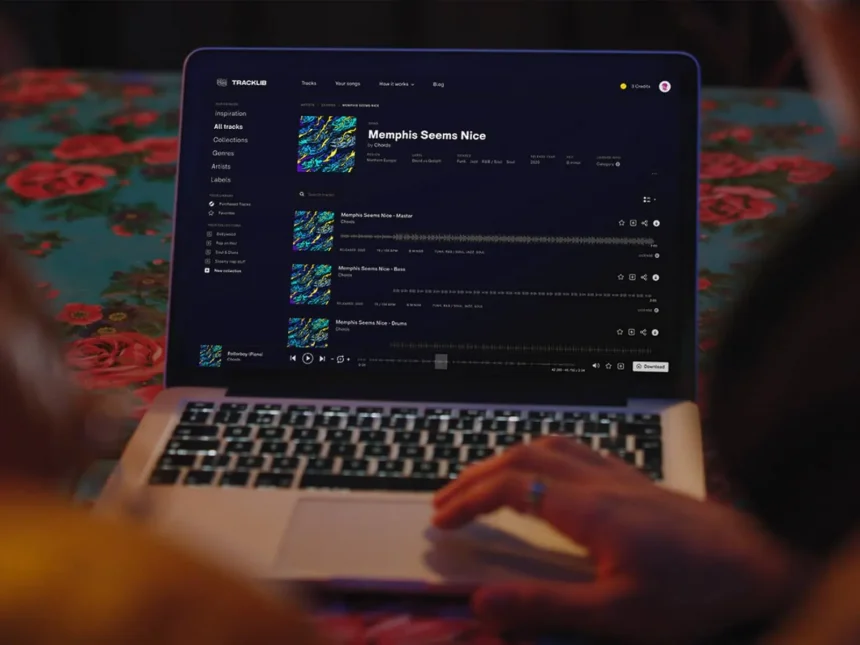
Tracklib is a subscription service (roughly $14.99–$19.99/month in 2026, with a monthly credit allowance in the hundreds) that gives you access to a catalog of over 100,000 real, previously released songs, many delivered as stems and multitracks. Crucially, these are rights-cleared: the platform has arrangements with the labels and publishers, so you can sample the record and release your song without hunting down rights holders yourself.
The trade-off is a royalty split. When you release a track built on a Tracklib song sample, you register it and share a percentage of that song’s future revenue — from both master and publishing income — with the original rights holders. The exact split is set by a rate card that factors in how the source song is categorized and how much of it you use (a two-second stab costs far less than a full 60-second loop). In practice these splits commonly land in the 10–20% range, though higher-profile catalog can run steeper. Tracklib has also folded unlimited sample clearance into its upper subscription tiers, removing the old per-clearance upfront fees for many users.
Tracklib also offers a Sounds section of royalty-free material, so it is not purely a record-licensing service — but the record catalog is why people come.
Best for: producers who want the sound and legal safety of sampling real records without the nightmare of manual clearance.
Black Octopus, Loopmasters, and one-time packs
Not everyone wants a subscription. Sometimes you just want to own a specific, curated collection of sounds forever.
Black Octopus Sound is a leading independent label here, especially strong in bass music. Its flagship Leviathan dubstep series is a good example of the one-time-purchase value proposition: Leviathan 4 sells for around $99 and delivers over 9GB and roughly 7,388 sounds — including hundreds of bass loops and one-shots, nearly 2,000 drum one-shots, FX, vocals, MIDI, and 325 Serum presets. Buy it once, keep it forever. Black Octopus also gives away a free 1GB sampler, and its packs are royalty-free with the standard restrictions (use them in your music freely; do not resell or redistribute the raw samples).
Loopmasters is the veteran royalty-free library and distributor, hosting a deep genre catalog (including a dedicated Dubstep section) and acting as a storefront for dozens of boutique labels. Like Splice, its content is royalty-free for use in your productions but cannot be redistributed as samples.
Best for: producers who prefer to own curated collections outright, avoid recurring fees, or want a specific artist/label sound.
How to choose
A simple way to decide:
- You want variety and constant new sounds, cheaply per month → Splice subscription.
- You want to sample an actual released record, legally → Tracklib.
- You want to own a specific high-quality collection forever → a one-time pack from Black Octopus, Loopmasters, or similar.
- You are broke and learning → start with free vaults (Cymatics, Ghosthack) plus a cheap Splice month.
Most working producers end up using two or three of these together. That is normal — each solves a different problem.
The bottom line
In 2026, there is no excuse for using illegal loops. Splice gives you a royalty-free firehose, Tracklib lets you sample real history legally, and labels like Black Octopus and Loopmasters let you own curated sound forever. Understand which model you are buying into, read the license, and you can build commercially releasable music with complete peace of mind.Sources: – Splice Plans & Pricing – Splice Sounds Licensing FAQ – Tracklib: How It Works – Splice vs Tracklib comparison (Tracklib blog) – Black Octopus Sound — Leviathan 4