


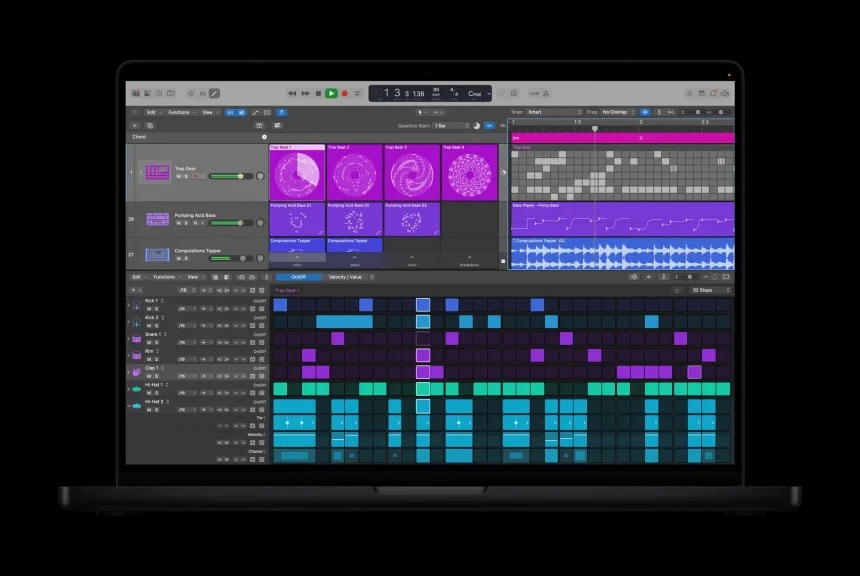
The DAW market in 2026 is crowded, competitive, and increasingly subscription-driven. Against that backdrop, Apple’s Logic Pro keeps doing something quietly radical: it charges you once, hands you a professional studio’s worth of tools, and then improves for free — as the July 2026 release of Logic Pro 12.3 proved yet again. This is the big-picture case for why Logic Pro 12 remains one of the best digital audio workstations you can run on a Mac, with an honest look at where it falls short.
The Value Proposition Is Almost Unfair
Logic Pro for Mac costs $199.99 as a one-time purchase on the Mac App Store. There is no monthly fee, no annual renewal, and no tiered edition that hides the good instruments behind a higher price. You pay once and you own it.
Compare that to the industry’s drift toward subscriptions and to competitors whose full feature sets can run three to four times Logic’s price, and the math becomes striking. Everything is included: every stock synth, every effect, every sampler, and the entire sound library. And crucially, updates are free. Logic Pro 12.3 — with its new Alchemy granular sync mode, upgraded Beat Breaker, and improved Chord ID — cost existing owners exactly nothing. Over the multi-year life of the software, that “buy once, get better forever” model is the single strongest argument in Logic’s favor.
Built for Apple Silicon, and It Shows
Logic Pro 12 requires a Mac with Apple silicon, and that tight coupling between software and hardware pays off. Apple designs both the chips and the DAW, so Logic runs demanding plug-ins and large sessions with excellent efficiency, low latency, and impressive stability. Producers routinely report high track counts and heavy instrument chains running smoothly on even the more affordable Apple silicon Macs. If you already own a modern Mac, Logic extracts more performance from it than almost any cross-platform alternative, because it was built specifically for that silicon rather than for the lowest common denominator.
A Genuinely Deep Stock Toolset
The reason $199.99 goes so far is the breadth and quality of what’s bundled. You are not buying a shell that needs expensive add-ons to become usable — Logic ships as a complete studio.
- Alchemy — a flagship multi-engine synthesizer (additive, spectral, formant, granular, virtual analog) that resynthesizes any sample. With 12.3 it gained a pitched granular sync mode and formant shifting, deepening an already vast instrument.
- Sampler and Quick Sampler — professional sampling, from detailed multisample instruments to instant one-shot chopping.
- Beat Breaker — tempo-synced audio slicing and rearranging, upgraded in 12.3 with per-slice filtering, resonance, panning, and smarter randomization for glitchy, rhythmic sound design.
- Session Players — AI-powered virtual musicians (drummers, bass, keyboard, and guitar players) that follow your chords and groove, generating convincing, editable performances. This is one of Logic’s genuine standout features, turning a blank arrangement into a band that plays along with you.
- Mastering Assistant — an intelligent mastering tool that analyzes your mix and applies transparent, professional-grade processing to get you to a competitive loudness and tonal balance.
- Stem Splitter — separates a finished audio file into drums, bass, vocals, and other parts, opening up remixing and sampling possibilities that used to require external software.
- ChromaGlow — analog-style saturation and warmth modeling for character and glue.
That list alone would cost a small fortune assembled from third-party plug-ins. In Logic it’s the starting point.
Spatial Audio and Modern Delivery Formats
Logic Pro has built-in support for Spatial Audio with Dolby Atmos, letting you mix immersive, three-dimensional audio directly inside the app and export in the format streaming platforms increasingly favor. For producers who want their work to be future-proof — and to sound great on AirPods, in cars, and on home systems that support Atmos — having a full Atmos mixing environment included at no extra cost is a serious advantage. This is professional-grade delivery capability that many competitors treat as a premium or plug-in-dependent feature.
Ecosystem Integration: Logic for iPad and the Apple Advantage
Logic Pro’s tight integration with the wider Apple ecosystem is easy to take for granted until you rely on it. Logic Pro for iPad — available through Apple’s Creator Studio subscription (about $12.99/month or $129/year) — lets you start ideas on a touchscreen with a genuinely capable, gesture-driven version of the app, then bring the project into Logic on the Mac to finish. Sample Alchemy and many of Logic’s most tactile tools feel right at home on iPad’s touch interface.
Beyond that, Logic plays nicely with the rest of macOS and iOS: seamless audio hardware handling, Handoff-style continuity of files, and integration with Apple’s audio frameworks. If you already live in the Apple ecosystem — iPhone, iPad, Mac — Logic slots in with almost no friction, and moving projects and ideas between devices is smooth in a way cross-platform tools struggle to match.
Honest Limitations
No DAW is perfect, and Logic has real drawbacks you should weigh.
- Mac-only. This is the big one. Logic Pro 12 runs exclusively on Apple silicon Macs. If you use Windows, Logic simply isn’t available, and it never will be. For a large chunk of producers, that alone rules it out.
- A learning curve. Logic is deep, and depth means complexity. The interface can feel dense to newcomers, and features like Session Players, Alchemy’s many engines, and the Environment/routing layers take time to master. It rewards investment, but it is not the fastest DAW to feel fluent in.
- Less of a live-performance focus. While Live Loops brings clip launching to Logic, the app is primarily a studio production and composition tool. Producers whose workflow centers on live performance or heavy loop-based jamming may find other DAWs more purpose-built.
- Apple silicon requirement. The performance benefits are real, but they come with a hardware floor — you need a reasonably modern Mac to run Logic Pro 12 at all.
The Verdict for 2026
Logic Pro 12 makes an unusually strong case in 2026 precisely because it resists the trends around it. In a market moving toward subscriptions and up-sells, Apple charges $199.99 once, includes a professional studio’s worth of instruments and effects, and keeps improving the software for free — 12.3 being the latest proof. Add best-in-class Apple silicon performance, standout features like Session Players and Mastering Assistant, built-in Spatial Audio, and smooth integration with iPad and the rest of the Apple ecosystem, and you have one of the most complete and best-value DAWs available anywhere.
The caveats are honest and important: it is Mac-only, it asks for patience while you learn it, and it leans toward studio production over live performance. But if you own an Apple silicon Mac and you want maximum capability for minimum long-term cost, Logic Pro remains, in 2026, one of the very best choices you can make.Sources: – Apple — Logic Pro – Apple — Logic Pro release notes (support.apple.com/en-us/109503) – SYNTH ANATOMY — Logic Pro 12.3 update overview – Gearnews — Logic Pro 12.3: Updates for Alchemy and Beat Breaker, Plus a New Sound Pack – audionewsroom — Logic Pro 12: All You Need To Know